Still Becoming: Learning to Testify to Love
by Stephanie Eft Seeger (MDiv ’17, Alumni Engagement & Communications Officer at Christian Theological Seminary)
One evening in January 2017, I sat beside a pool behind a rented house in Marco Island, Florida, talking about God long after class had ended.
I had traveled to Florida by myself for Becoming a Public Theologian: Christian Activism in the 21st Century, an intensive CTS course taught by author and public theologian Brian McLaren. The class brought together CTS students and participants in the then-new OPEN Network, an initiative hosted at CTS that gathered people from different Christian traditions who were exploring new ways of doing theology, creating community, and living out their faith.
Many of us had something else in common, too. Our experiences in ministry, leadership, relationships, and life had led us to question some of the narrower understandings of Christianity we had inherited. We were learning that asking questions of our theology didn’t necessarily take us farther from God. Sometimes those questions opened us to an understanding of God that was larger, more loving, and more expansive than we had previously imagined.
And those conversations didn’t end when class dismissed.
That evening, several of us gathered at a house where some of the students were staying. Sitting outside near the pool, our conversation continued late into the night. We talked about ministry and church, what we had been taught, what we had let go of, and what we were discovering about the radically reconciling nature of God’s love.
Among the people sitting there were Melissa Greene (MDiv ’20) and two other students, Josh and Tina.
At some point during the evening, I discovered that Melissa had once been a member of the contemporary Christian music group Avalon.
Suddenly, I put the pieces together.
That Melissa Greene.
I had listened to Avalon growing up. I was a youth group kid who eventually studied to become a youth minister. I owned their CD. I knew the music.
I knew the contemporary Christian radio hit “Testify to Love.”
I couldn’t have imagined then how much that song and that conversation would eventually mean to me.
A Theology Big Enough for Me, Too
My own theology had already changed significantly before that night in Florida.
When I applied to CTS in 2013, I described my faith as an ongoing search for truth. I had come to believe two things with certainty: God is real, and I am not God. Everything else had to be approached with enough humility to acknowledge that sometimes I would be wrong.
Seminary gave me language for a process that had already begun. In Systematic Theology, I wrote about moving from an “embedded theology” – beliefs absorbed from family, church, and culture – toward a more deliberative theology in which I could name those beliefs, examine them, and sometimes challenge them.
By 2017, I had developed a theological framework grounded in what I understood to be God’s loving and reconciling nature. In the final paper I wrote for Becoming a Public Theologian, I described Christian salvation not primarily as something awaiting us after death, but as “radical love, radical inclusion, radical justice, and radical equality” breaking into this life.
That included LGBTQ+ people.
My time at CTS, particularly the relationships and conversations I experienced with my seminary cohort, had helped me firmly believe that LGBTQ+ people are made in the image of God and reflect God’s image. I had come to believe something even more expansive: queerness wasn’t outside God’s character or merely something God’s love was generous enough to tolerate. Queerness itself could reveal something of the expansive image of God.
Theologically, I believed that.
Personally, I still had some catching up to do.
I had also been formed by the purity movement that shaped much of the Christian youth culture of my adolescence. Some of the shame I had learned around bodies, sexuality, desire, and identity remained with me even as the theology surrounding it was beginning to fall away.
And so that night beside the pool, our conversation became personal.
I began sharing with Melissa, Josh, and Tina about my own experiences with identity and sexuality and the understanding of myself that was slowly becoming clearer as I let go of some of that long-held shame.
They listened.
They asked thoughtful questions.
They encouraged me to keep exploring.
No one tried to tell me who I was. No one gave me an answer I wasn’t yet ready to give myself. They simply created room for me to wonder aloud.
At the time, I wasn’t out – to anyone, including myself.
Looking back, however, I recognize that conversation as one important step along the way.
Stepping Into My Truest Self
Two years later, in 2019, I came out.
There was plenty to process as I began more fully understanding my sexuality and stepping into what I have since described as my truest self. But I had one extraordinary gift already in place: I didn’t also have to decide whether the person I was discovering myself to be could be loved by God.
My theology had gotten there before I had.
Years before I was able to name my own queerness, I believed queer people reflected the image of God. I believed God’s love was radically inclusive and reconciling. I believed Jesus challenged systems that assigned different levels of worth to different kinds of people.
And, perhaps most importantly, I had already written into my theology the importance of loving myself.
In my 2016 systematic theology credo, I wrote that my calling involved helping others discover how to love themselves, God, and the created world around them. A year later, in the paper I wrote after the class with Melissa, I said that my success in ministry and leadership could only be measured by the capacity with which I had “loved God, loved myself, loved creation, and helped those around me to do the same.”
I didn’t know when I wrote those words how much I would eventually need them.
The challenge wasn’t developing a new theology to make room for myself.
It was trusting that the theology I already believed about everyone else really included me, too.
Hearing an Old Song Again
Nine years after that evening in Marco Island, Melissa’s voice unexpectedly brought me back to it.
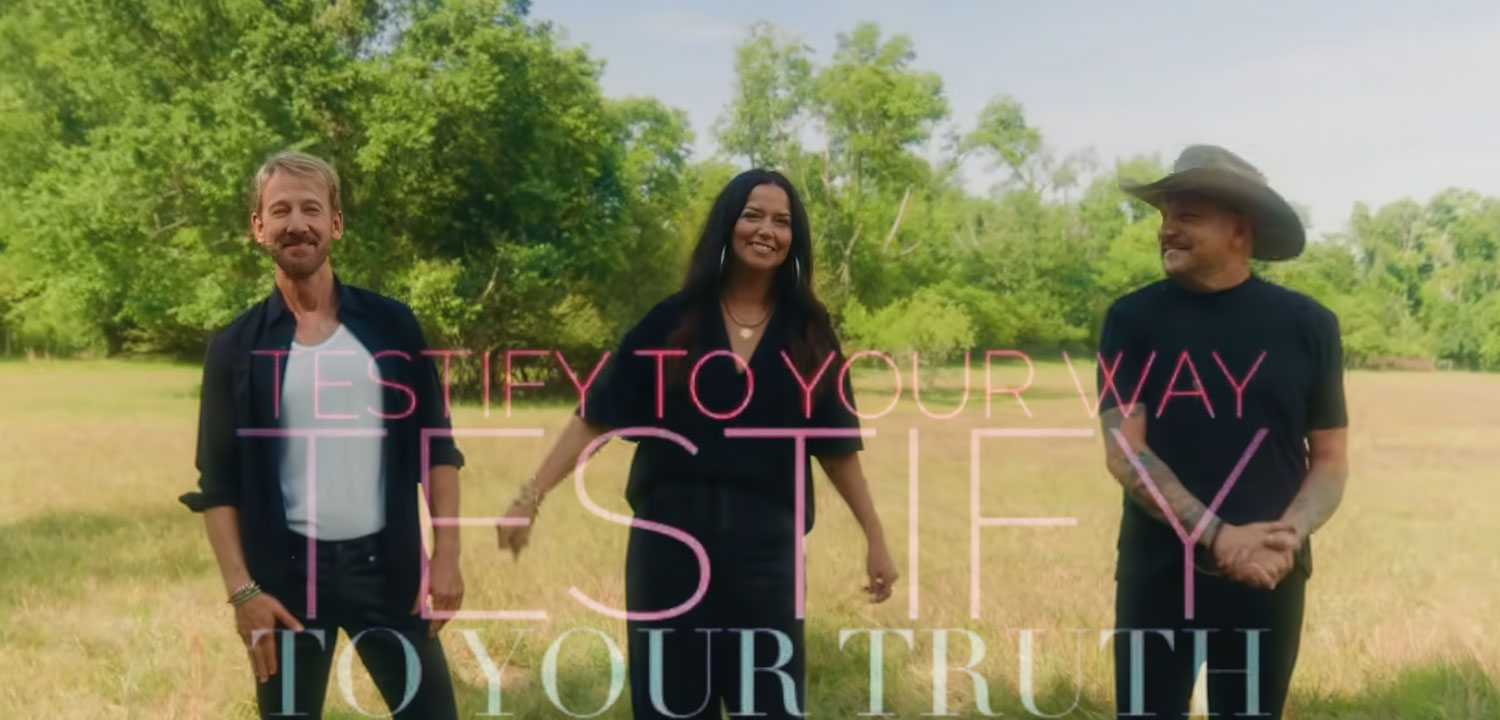
This May, Melissa joined former Avalon member Michael Passons and country artist Ty Herndon for a new recording of “Testify to Love,” the song Avalon originally released in 1997.
Watch the official music video above, or listen to “Testify to Love” on your preferred streaming platform.
But this was more than a nostalgic reunion.
Passons was a founding member of Avalon and is gay. He has spoken publicly about being forced out of the group in 2003 after his sexuality became known. Melissa, who had joined Avalon the year before, has also spoken candidly about the theology she held at the time and her role in what happened.
She believed then, she now says, that some expressions of love were acceptable and others weren’t.
She no longer believes that.
Over the years, Melissa and Michael rebuilt their friendship. They continued singing together. Their understandings of faith, love, and belonging continued evolving, too.
Melissa today describes herself as “peacefully post-Christian.” Christianity, she says, will always be part of her life and has deeply shaped her, but she no longer identifies as a person of faith in the way that phrase is commonly understood. What has remained is a deep curiosity – about the divine, about humanity, about our connection to one another, and about our responsibility for how we live.
Then, after performing “Testify to Love” with Herndon at his Concert for Love & Acceptance, an idea emerged: record it again.
The new version was released May 15, this time as an explicit affirmation of expansive love and inclusion, particularly for LGBTQ+ people. The rerecording quickly found an audience, reaching No. 1 on the iTunes Christian & Gospel chart and debuting at No. 3 on Billboard’s Christian Digital Song Sales chart.
For Melissa, returning to the song also meant returning honestly to its history.
She hasn’t attempted to erase the person she once was or pretend she always believed what she believes today. Instead, she has publicly acknowledged that she supported what happened to Michael and has described the long, complicated process through which her understanding of the divine changed.
That part of Melissa’s story stopped me.
Because I thought again about the woman sitting beside a pool with me in 2017.
The Melissa I encountered that night listened while I tentatively explored my own identity and theology. She asked questions. She encouraged me. She helped create a space in which I felt safe enough to wonder who I might be without the shame I had carried from an earlier form of Christianity.
Until this rerelease, I hadn’t fully connected that experience with the distance Melissa herself had traveled to become that person.
When I asked her recently what had been happening in her own journey by the time we met in 2017, Melissa told me she had reached a place of full LGBTQ+ inclusion – but only after a yearslong process.
“My heart got there before my head did,” Melissa said. “I was voting for the civil liberties of my gay friends back in 2008, long before I had the theology to explain why. In 2015 I helped lead GracePointe, the church where I served as a pastor, to full inclusion.”
By the time we sat beside that pool, however, Melissa was approaching another significant transition. She was six months away from resigning from GracePointe and leaving the church altogether. And what was continuing to shape her understanding of the divine wasn’t primarily theological ideas.
“What kept shaping my view of the divine wasn’t ideas. It was people,” she said. “Specifically, people who were incarcerated. I spent five years doing prison ministry exclusively, and it changed how I see people and how I understand the way God and love need to operate in this world.”
Still Becoming
There is a line from the paper I wrote after our class that feels different to me now.
“Public theology is a way I can help usher in reconciliation and radically inclusive love on this earth.”
At the time, I was trying to articulate what I had learned about bringing theology out of churches and classrooms and into the public square. I wrote about activism, justice, racism, reconciliation, community organizing, and the responsibility to challenge systems that diminish human worth.
But nearly a decade later, I think some of the most important public theology I encountered that week happened after class.
It happened around a pool.
It happened when people told the truth about the faith they had inherited and the beliefs they could no longer hold.
It happened when someone trusted other people with a part of herself she couldn’t yet name.
It happened when those people responded with curiosity instead of judgment.
And it continues to happen when someone is willing to say publicly: I believed this once. I understand differently now. Someone was hurt. What does love require of me today?
For Melissa, her restored relationship with Michael became one place where changing her beliefs had to become something more than changing her mind.
“I had to live into those views,” she told me. “I had to name how I’d changed. I had to make amends and apologies for the harm some of my actions had caused.”
Maybe that is part of what it means to become a public theologian.
And maybe the word becoming matters as much as the words public theologian.
When I applied to CTS in 2013, I wrote about the importance of remaining open to the possibility that I might be wrong. In Systematic Theology, I wrote about learning to identify and challenge the beliefs I had inherited. In Marco Island, I sat with other people doing much the same thing.
Melissa has been thinking about becoming, too. She began writing a memoir when she left the church in 2017, and she told me the experiences surrounding “Testify to Love” are helping her write its ending – with an important distinction.
“Not the ending of my becoming,” she said. “The ending of this chapter.”
None of us was finished.
We still aren’t.
Testify to Love
That’s part of why hearing “Testify to Love” again has affected me so deeply.
The song belongs to more than one version of my life.
It belongs to the youth group kid who listened to Avalon and absorbed a Christian culture that gave me both a genuine love of God and ideas about sexuality I would eventually need to unlearn.
It belongs to the seminary student sitting beside a pool in Florida, increasingly convinced that God’s love was more radically inclusive than she had once understood while still cautiously discovering what that might mean for her own life.
And it belongs to me now.
Melissa first sang “Testify to Love” more than 20 years ago. What the song means to her now, she told me, feels different.
“Back then, love was something I was trying to convince people of. Now it’s something I’m reminding them they already have.”
Today, she said, “Testify to Love” is about remembering “that love surrounds us. That love is for us, willing us to expand, to continue to become. That love is already inside us.”
I understand something about that.
The song didn’t need to become large enough for Michael Passons to belong within its vision of love.
Michael was already worthy.
God’s love was already large enough.
What had to change were the people and systems drawing the boundaries.
Nine years ago, Melissa and I sat with a handful of other people in a class called Becoming a Public Theologian. I don’t think either of us could have known where our own becoming would take us.
I couldn’t have known that two years later I would come out and discover that some of the theological room created through conversations like the one we shared that night would help me step more fully into myself.
And I certainly couldn’t have known that nine years later, I would hear Melissa’s voice singing a song from my youth again – this time beside Michael Passons – and understand it in an entirely different way.
Maybe our testimony isn’t that we understood love perfectly the first time.
Maybe it is that we remained willing to encounter God and one another, to question the boundaries we inherited, to tell the truth when we got something wrong, and to keep becoming people capable of loving more fully.
For me, that’s what it means now to testify to love.